Print Ship USA
5/10/2026
The Foundation of Great Print
The paper you choose for your printing project is just as important as the design itself. The right paper stock can elevate a simple flyer into a premium marketing piece, while the wrong choice can make a brilliant design feel cheap. Understanding paper weights, coatings, and finishes is key to achieving your desired result.
Understanding Paper Weight
Paper thickness and weight are commonly measured in pounds (lb) or points (pt). Generally, the higher the number, the thicker the paper.
Text Weight vs. Cover Weight
Text Weight (or Book Weight): This is lighter, flexible paper, similar to what you use in a standard office printer, or the pages of a magazine. It's ideal for the interior pages of booklets, letterheads, and standard flyers. Common weights include 70lb, 80lb, and 100lb Text.
Cover Weight (or Cardstock): This is thicker, stiffer paper, similar to a greeting card or business card. It's used for the covers of booklets, postcards, business cards, and premium flyers. Common weights include 80lb, 100lb, 14pt, and 16pt Cover.
Note: A 100lb Text paper is NOT the same as a 100lb Cover paper. The Cover paper is significantly thicker.
Paper Coatings: Gloss, Matte, and Uncoated
During the manufacturing process, paper can be coated with a clay compound to smooth the surface and affect how it absorbs ink.
1. Gloss Coated
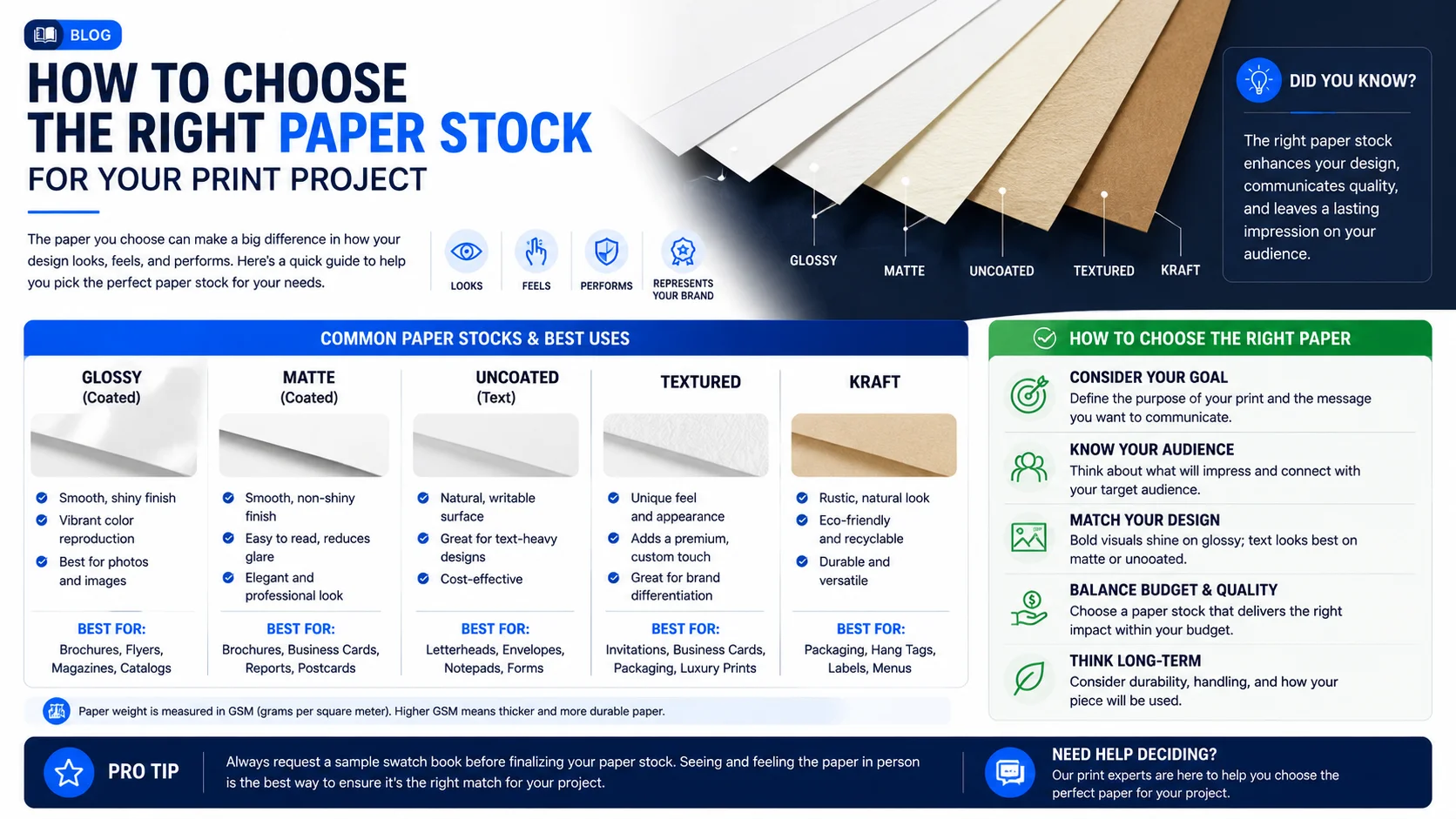
Gloss paper has a high shine. It reflects light and makes colors look vibrant, saturated, and punchy. It provides a sharp, crisp resolution for images.
Best for: Photographs, promotional flyers, brochures, and anything where you want images to pop.
2. Matte/Silk Coated
Matte (sometimes called silk or dull) paper is coated but has very little glare. It feels smooth to the touch and offers excellent readability because it doesn't reflect harsh light. Colors appear slightly more subdued but elegant.
Best for: Text-heavy documents, luxury brochures, art prints, and professional presentations.
3. Uncoated
Uncoated paper has no surface coating. It has a natural, slightly textured feel (like standard printer paper). Because there is no coating, ink absorbs deep into the paper fibers, causing colors to appear slightly softer and darker.
Best for: Letterheads, envelopes, forms, and anything that needs to be written on with a pen or pencil.
Specialty Finishes
After printing, additional coatings can be applied to enhance durability and aesthetics:
- Aqueous Coating (AQ): A clear, water-based coating applied to the entire sheet to protect against scuffs and fingerprints.
- UV Coating: A liquid coating cured by ultraviolet light. It creates an extremely high-gloss, slick finish that makes colors incredibly vibrant and provides strong protection. Note: You cannot write on UV coated paper.
- Soft Touch (Velvet): A specialty coating that gives the paper a luxurious, velvety texture that feels like suede or soft leather.
By carefully selecting the right weight, coating, and finish, you ensure your printed materials perfectly convey your brand's message and quality.